Saturday, November 30, 2013

No. 814: Fiber made of carbon nanotube is developed by Kuraray's subsidiary (November 29, 2013)

Technology:
Kurarayliving, one of the subsidiaries of Kuraray, developed fiber made of carbon nanotube. Because carbon nanotube has 10 times higher heat conductivity than copper, it can increase the temperature of a 70 cm-square cloth instantly using 100 volt electricity. In addition, the new fiber decreases power consumption by more than 20%. In the initial stage, the company plan to apply it to heating appliances like electric carpet as well as to snow melting equipment.

Polyester fiber is emerged in a liquid in which molecules of carbon nanotube are dispersed evenly for coating. In the past, it was rather hard to put in molecules in the same density when powder carbon nanotube is dissolved in a liquid, but Kurarayliving developed a special solvent that allows molecules to line in the same density for the first time in the world. The company plans to market the new fiber to electric appliance manufacturers starting December. It will be sold for 10,000 yen per square meter, and mass production is expected to halve the price in the future. 

 Kuraray corporate profile

Friday, November 29, 2013

No. 813: An unmanned flight robot for the inspection of infrastructures (November 28, 2013)

Technology:
An unmanned flight robot


Prof. Kenzo Nonami of Chiba University developed an unmanned flight robot with six propellers. Equipped with a camera and the GPS, it can fly 3 km around freely to take pictures. It can fly through between bridge beams and windmill vanes and stand still in air, and go up to 500 m above the ground fast like a rocket if necessary.   

The robot returns to the base automatically when the battery runs out. The operator can fly it again after he replaces the battery with a new one. Prof. Nonami is now developing a technology to allow the robot to go down to the ground with the help of a parachute when it goes out of control while flying. It is designed to inspect the deterioration of such infrastructures as solar panels of photovoltaic generation, windmills of wind generation, bridge beams, and piping of iron works. It will be put on the market next spring.  

 Demonstration video of the unnmanned flight robot

Tuesday, November 26, 2013

No. 812: Successful development of the world’s thinnest and lightest car windshield (November 27, 2013)

Technology:
Nippon Sheet Glass developed the world’s thinnest and lightest car windshield. The new windshield is 3.75 kg, 1 kg lighter than the existing car windshield of the same size. It has been adopted by Toyota’s three-wheel two-seater electric vehicle “i-ROAD” that has a 90 cm high and 50 cm wide windshield.  

The company reviewed the heating process of glass production, and developed 1 mm thick glass and glued it with another 2 mm thick glass to build a 3.75 mm thick windshield. Traditionally, two 2 mm thick glass sheets are glued together to build a windshield. If the new windshield glass is adopted by a four-wheel vehicle, the size of the windshield will be doubled. However, a vehicle that adopts the new windshield will be several kilograms lighter than the vehicle equipped with existing windshield of the same size. Nippon Sheet Glass plans to market the new windshield as a product that helps reduce fuel consumption. Nippon Steel Glass has about 25% share in the world’s car windshield market. 

Toyota's i-ROAD travels in Europe

Toyota's i-ROAD in the Tokyo Motor Show

No. 811: A cooling unit for a liner motor car that reduces helium gas consumption to 1/1000 (November 26, 2013)

Technology:
Air Water developed a cooling unit for the next-generation linear motor car in collaboration with Railway Technical Research Institute. Because the new unit utilizes compression and inflation of helium gas, it can reduce helium consumption to less than 1/1000 of the helium consumption of the existing cooling unit. 

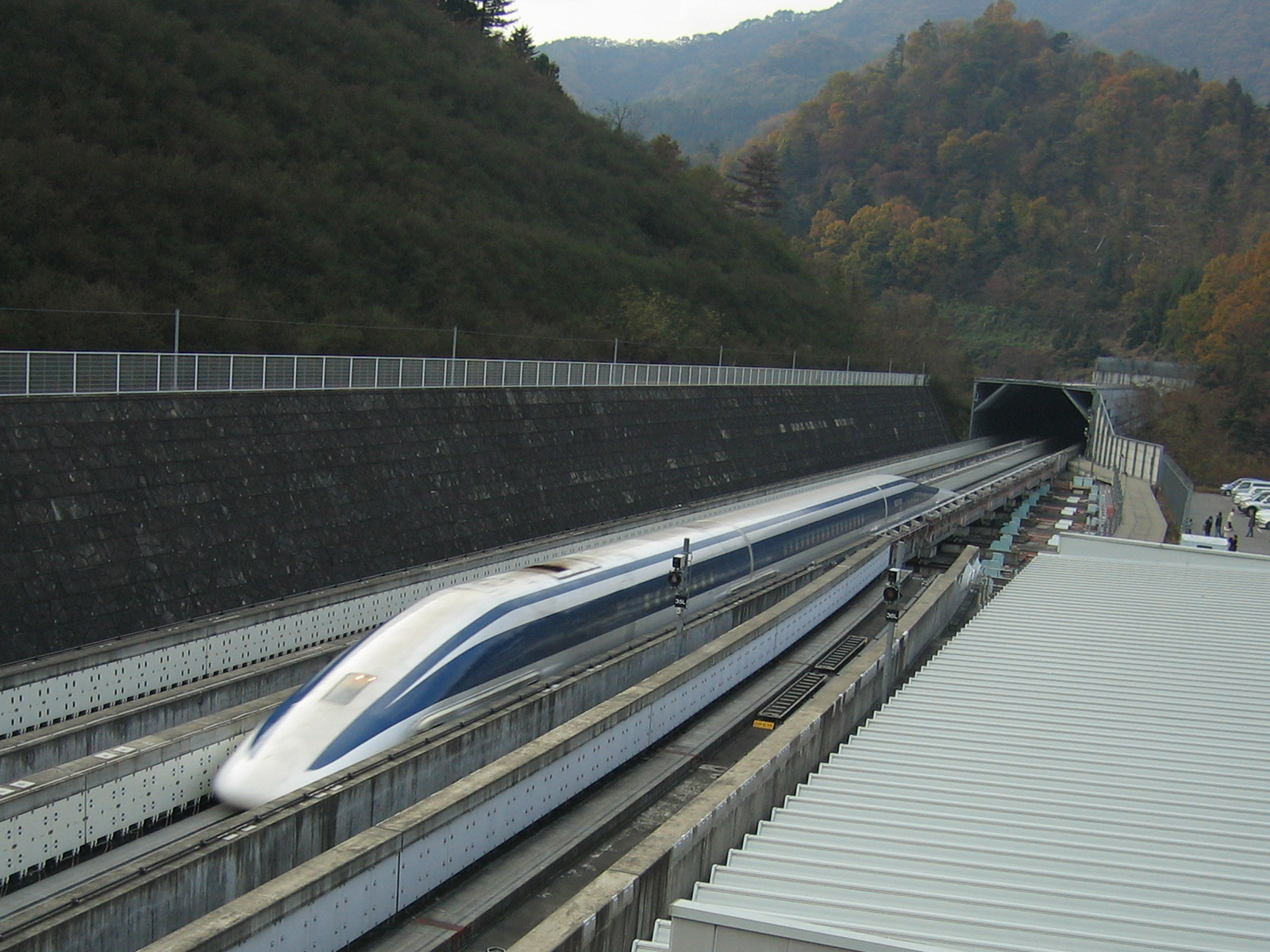
The new cooling unit sends compressed helium gas into the closed stainless tube in a uniform rhythm, and cools down semiconducting coils by repeating compression and inflation of helium gas. It can cool a semiconducting coil down to minus 223 degrees centigrade. It will be installed in the body of liner motor car, and four units will be enough to cover one car. The Liner Chuo Shinkansen is scheduled to be inaugurated in 2027, and it is decided to use liquid helium of minus 269 degrees centigrade for the cooling unit of semiconducting coils.   

  A five-car Linear Chuo Shinkansen 
travels at 500km/h in a test

Friday, November 22, 2013

No. 810: Plant-derived tire is developed by a Japanese tire manufacturer (November 22, 2013)

Technology:
Sumitomo Rubber will put an oil-free tire on the market on Nov. 22 for the first time in the world. The oil-free tire is made of plant-derived materials including corn and field mustard. Oil-derived materials usually account for 60% of the existing tire. 

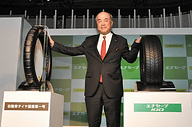
 The newly-developed oil-free tire (righjt) and 
a replica of the first tire produced in Japan (left)
 
The new time will be sold under the brand name Enasave (saving energy in Japanese) 100. It is 1.2 times stronger against wear than the existing tire. The suggested retail price of this new tire (195 mm wide) is 21,105 yen. The company plans to sell a tire whose rolling resistance coefficient is 50% lower than the existing tire in 2014, showing their determination to place the highest importance on developing products characterized by energy-saving and low-fuel consumption. The following two web pages explain Sumitomo's Enasave more in detail (in Japanese). 


Sumitomo's Enasave vs. Bridgestone's Regno

Thursday, November 21, 2013

No. 809: Successful development of a new LED chip capable of reducing blue light by 95% (November 21, 2013)

Technology:
Showa Denko developed an LED chip that reduces blue light coming out from PC and smartphone screens by 95%. LED illuminations and liquid crystal displays use a blue LED as the main light source. A blue LED is said to be liable to make eyes dry and keep a man from falling asleep. The company successfully reproduced light almost the same as the light source of a blue LED by combining three colors of LED chips: purplish red, yellow, and blue green. The existing purplish red LED does not have enough brightness to be used as the light source of illumination, but the company successfully increased its brightness.

Because the newly developed LED chip does not use a blue LED, it can reduce blue light by 95%. Showa Denko wishes to commercialize the new LED chip and put it on the LC display and LED lighting market toward 2014. The new LED chip will be 2-3 times higher in price than a blue LED, but the price increase of lighting and LC display that incorporate the new LEC chip will be between 20% and 30%. It is estimated that 10 billion blue LED chips are produced monthly worldwide, and the company estimates the potential demand for replacement will be about 5% of the world production. 

Blue LED chips are flushing to reduce
traffic accidents at a tunnel exit in Tokyo

Wednesday, November 20, 2013

No. 808: A new approach to the prediction of torrential rainfall (November 20, 2013)

Technology:
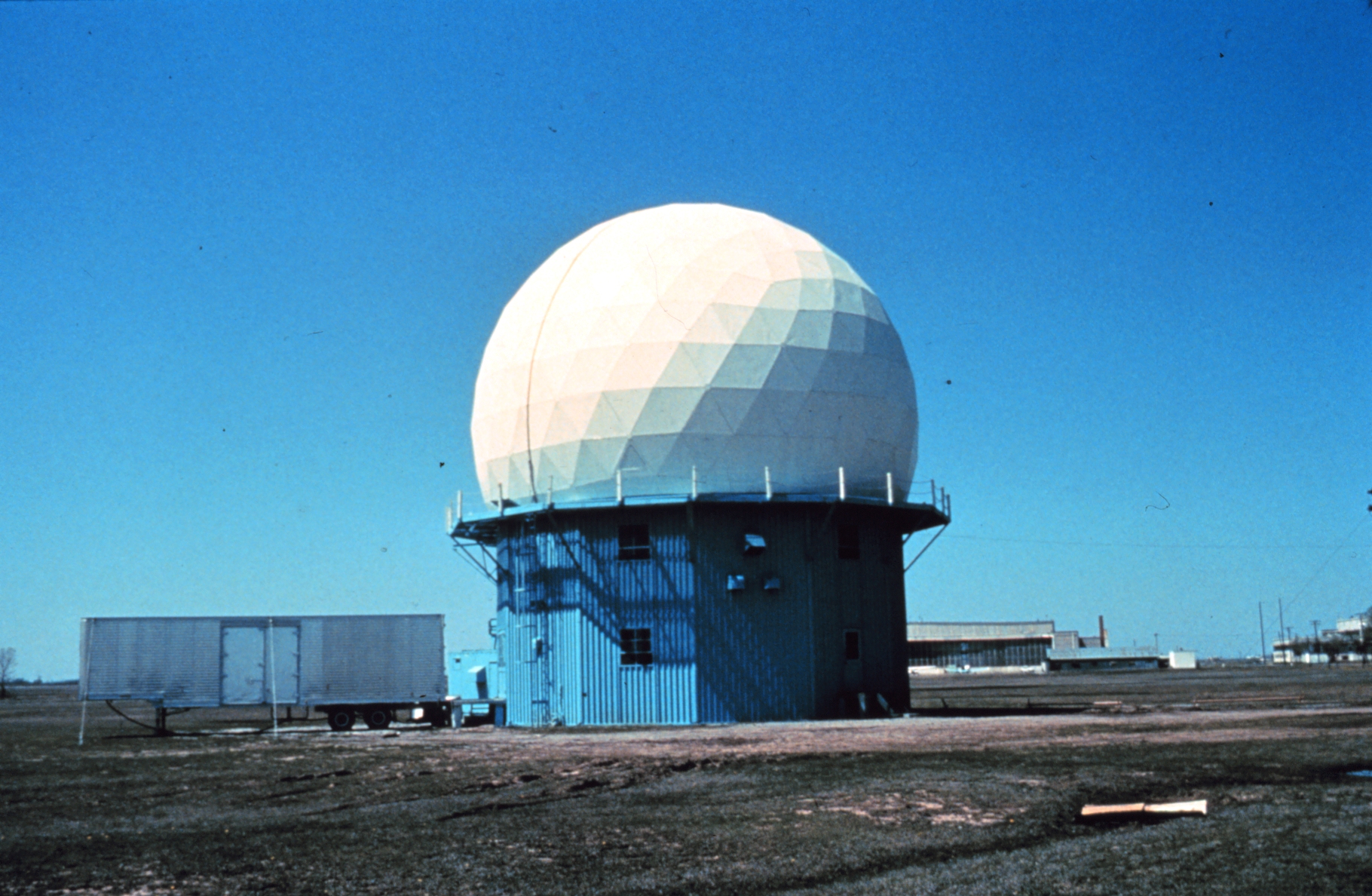
A Doppler radar
A research team led by Director Hiromu Seko of Meteorological Research Institute developed a new approach to increase the prediction accuracy of regional torrential rainfall. The new approach determines the increase and decrease trend of water vapor content with the help of radio waves that reflect off obstacles like transmission line tower and return to the observation radar of Japan Meteorological Agency, and take them into consideration for the calculation of precipitation and the region subject to rainfall. 

Because the Doppler radar cannot get data without raindrops, it cannot measure water vapor content before it rains. The research team calculated the refractive index of air using the conditions of radio waves returning from transmission line towers and confirmed that the increase and decrease trend can be determined from the time change the refractive index. They put the trend together with such data as temperature and wind in the calculation model and reproduced the lightening storm that hit the Tokyo Metropolitan area on August 4, 2008 and found that the experimental data agreed with the actual rainfall. The research results are scheduled to be presented in the autumn meeting of Meteorological Society of Japan on November 21. 

The torrential rainfall that hit Tochigi Prefecture
in the Kanto district on July 27, 2013