Thursday, November 8, 2012

No. 641: Monitoring the water level of a river using laser (November 8, 2012)

Technology:
Mitsubishi Electric Engineering, a group company of Mitsubishi Electric, developed a system to detect an increase of the water level of a river in real time by irradiating laser over a wide range and analyzing the reflection it gets from the watch item. Because laser can detect slight variations, the system can analyze the place that is dim due to plume and dense fog. The company plans to commercialize the system in two years.

Called “Field Viewer,” the system is made up of laser irradiation equipment and cameras. It irradiates about 8,500 lasers to the watch item and analyzes the reflection data. It is rather hard to predict a flood from a river by a water level indicator or visual observation in the case of a thick haze and a short-lasting heavy rain like guerrilla rainstorm. The new system, however, can detect even a subtle change of water level instantaneously, and the picture image of an increase of the water level can be displayed on the monitor of the PC of the superintendent.

The laser have an effective range of up to 250 m. Based on the analysis of reflection, the system can measure the distance between the irradiation point and the watch item within a measurement error of less than 10 cm. Detailed standards will be decided in the near future for the commercialization of the system. 

Wednesday, November 7, 2012

No. 640: Increased luminous efficiency of a green light emitting diode (November 7, 2012)

Technology:
NGK Insulators confirmed that the gallium nitride wafer it developed with Hiroshi Amano of Nagoya University doubles the luminous efficiency of a green light emitting diode as compared with the existing green light emitting diode.

In the experiment of a green light emitting diode that uses the newly developed gallium nitride wafer, the internal quantum efficiency that shows luminous efficiency doubled to 60%. The company has already achieved luminous efficiency of 90% in blue light emitting diode. The company plans to quintuple the monthly production capacity of gallium nitride wafers to 1,000 pieces in 2013. Please click here to read detailed information.   

 NGK Insulators successfully doubled the 
luminous efficiency of a green LED

Monday, November 5, 2012

No. 639: Zeon starts mass production of single-walled carbon nanotubes next January (November 6, 2012)

Technology:
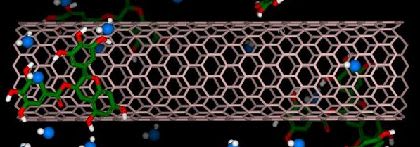
Zeon will start mass production of single-walled carbon nanotubes in January 2013 for the first time in the world. Single-walled carbon nanotube was developed by Sumio Iijima of the National Institute of Advanced Industrial Science and Technology (AIST) early 1990. It is excellent in heat and electric conductivity besides being high in intensity. It is a rather promising material for electric vehicle motors and electronic circuits. Because it stores energy effectively inside the hollow in the tubular carbon atom, it can be used for a material of the electrode of lithium-ion battery.

The production cost of single-walled carbon nanotube used to be too high to translate it into practical use. Actually, it cost several tens of thousands to produce one gram of single-walled carbon nanotube. Zeon and AIST succeeded in reducing the mass production cost considerably. They produced a single-walled carbon nanotube by applying hydrogen to the stainless substrate coated with elementary particles of iron with the help of a catalyst. Because adding a small amount of water can increase the purity of carbon easily, the production cost will be around several hundreds yen per gram.

Zeon plans to mass produce single-walled carbon nanotubes starting next January. In the initial stage, the company will produce 600 grams per day and ship finished products to chemical companies that will develop applications to make the best use of the product characteristics. Zeon will gradually increase the volume of mass production to reduce the production cost to several tens of yen, and construct a plant toward 2015.

Because a single-walled carbon nanotube has a high degree of elasticity and strength, it can be used for electronic paper, super-thin touch panel, and artificial skin. In addition, because it can absorb broadband light, research is under way to apply it to infrared sensor and absorber of electromagnetic wave. A single-walled carbon nanotube has 20 times higher tension strength than high-strength steel, 1,000 times higher density tolerance for high current and 10 times higher heat conductivity than copper, and has a half mass of aluminum.     

 Single-walled carbon nanotube

No. 638: A high-performance electrolyte film for fuel cell with a reduced additive amount of phosphoric acid (November 5, 2012)

Technology: 
A research team led by Atsunori Matsuda of Toyohashi University of Technology developed a high-performance electrolyte film for fuel cell with a reduced additive amount of phosphoric acid. Using an inorganic compound with a high degree of conductivity of the hydrogen ion, the research team successfully reduced the additive amount of phosphoric acid to one third. The maximum output of a fuel cell using this electrolyte film reached the world’s highest level of 350 mW per square centimeter at 160 degrees centigrade without humidification.

The inorganic compound used for the electrolyte film is a powder made by mixing inorganic heteropoly acid containing tungsten and silicon with hydrogen cesium sulfate in a ball mill. The research team induced a chemical reaction by mixing them while giving impact mechanically. Because the surface is activated, the hydrogen ion has a high degree of conductivity, and the high degree of conductivity is maintained throughout a wide range of temperatures. Accordingly, the operation temperature of a fuel cell is between minus 20 to plus 160 degrees centigrade.


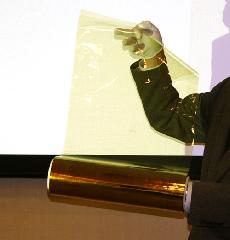
The electrolyte film used for Honda’s fuel cell vehicle FCX  

Saturday, November 3, 2012

No. 637: Application of biomaterials is spreading (2/2) (November 4, 2012)

Business trend:
Japanese leading trading companies are expanding the business of biomaterials in alliance with foreign companies. Itochu invested in ZeaChem of the U.S. that has the technology to refine bioethanol from plants using an enzyme collected from intestinal microorganism of termite. Mitsui and Co. is constructing the world’s largest plant to produce bio resins in Brazil in alliance with Dow Chemical of the U.S. They will establish an integrated system of production from raw material to finished product inside the premises with a view to producing bioresins at a cost comparable to producing them using oil-derived materials.

The Japanese government decided to take initiative in developing an enzyme for effective production of resin materials from wood, and held a meeting with some 30 leading companies in the related fields. It plans to allocate a budget of several billions of yen for 2-3 years for joint research. Some Japanese companies have already been developing advance technology for biomaterials. Ajinomoto is producing 1 million ton of amino acids annually by fermenting various plant materials like rice and tapioca. Ajinomoto may be the only company in the world that has an integrated system to procure plant materials, transport them, and utilize the effluent. Using Ajinomoto’s technology, Bridgestone is developing a technology to produce synthetic rubber from plant. Ajinomoto is developing a microorganism for the production of isoprene through fermentation, while Bridgestone will process isoprene to rubber using the enzyme technology.

Leading engineering companies are also energetic in developing biomaterials. JGC created a special team three years ago to develop large-scale equipment for effective production of resin materials with the help of microorganisms. Western companies are ahead of Japanese companies in developing such natural resources as oil, but Japanese companies are trying hard to increase the presence in the production and application of biomaterials.  

Please click here to see images of Toyota cars 20 years later that employs lots of biomaterials.

No. 636: Application of biomaterials is spreading (1/2) (November 3, 2012)

Business trend:

Efforts to apply biomaterials to auto parts and home electric appliances are accelerating. Toyota told its suppliers that it would give higher priority to biomaterials than oil-derived materials on the condition that biomaterials to be employed should have the same cost competitive and quality offered by the existing materials. SAI, Toyota’s hybrid car, has seats made of polyethylene terephthalate (PET) developed jointly by Toyota and Toyota Tsusho. The PET they developed is as smooth and has the same degree of abrasion resistance as the oil-derived PET. They successfully reduced the cost of the plant-derived PET to the same as the oil-derived PET by importing plant materials from India. Plant-derived materials now account for 80% of the total area of SAI’s interior decorating. Toyota plans to increase the number of models that use plant-derived materials. Please click here to see images of a Toyota car to be build 20 years later that employs lots of biomaterials. 

The usage of biomaterials started in the mid-1990s, and they were mostly used for containers in the initial stage because they were relatively high in price and did not have enough functions to be used for industrial purposes. In addition, they were not stably procured because they were under the influence of supply and demand of food. The technology to utilize nonfood plants like wood has been developing quite rapidly recently, and the mass production technology reduced the application cost. Today, plant-derived materials higher in performance than oil-derived materials are available.

The plant-derived nylon jointly developed by Toray and Ajinomoto has the same heat resistance and strength as oil-derived nylon. It has two times higher ability to absorb and desorb moisture than oil-derived nylon. Toray plans to apply the plant-derived nylon to stockings and undershirts. Unitika constructed a plant to produce resins made of ricinus produced from a kind of sesame. The Unitika’s plant-derived resin can be produced at the same cost as oil-derived resin. Moreover, it is had to deform and has a higher degree of heat resistance than oil-derived resin. The company plans to sell the plant-derived resins to fuel tubes of cars and connectors of electric appliances. Mitsubishi Chemical wishes to increase the share of biomaterials for its resins to 20%, and Mitsubishi Rayon tries to increase its share to 50%.

Company
Approach for biomaterials
Major applications
Unitika
Mass producing highly heat resistant polyamide resins
Auto parts
Ajinomoto
Joint development with Bridgestone, and Toray
Tires, clothes
Mitsubishi Chemical
Mass producing high performance plant-derived resins
Auto parts
Mitsubishi Rayon
Increase the share of biometerials of acrylic resins to 50%
Home elecctric appliances
Joint development of plant-derived materials for lithium-ion battery
Battery 

Thursday, November 1, 2012

No. 635: Think, and you can operate a home appliance (November 2, 2012)

Technology:
A smart house was shown to the public on November 1. In this house, you can operate a wheelchair and a home electric appliance only by forming your idea on how you want them to do. That is, the sensor attached to the head of the resident transmits the change of brain waves to the computer that gives instructions to a wheelchair. The smart house was developed jointly by Sekisui House, Shimadzu, and NTT. The research team plans to put the smart house technology into practical use in 2020.

The system utilizes the phenomenon that brain waves and the blood flow in the brain change when a man forms an idea. It detects the change of brain waves using light transmissive inside of the body. By comparing the data of brain waves with preinstalled data, it reads the instructions that the resident gives. Patterns of brain waves are stored in a database, and brain waves coming from the resident are compared with those in the database via the network. Various sensors of infrared light and ultrasonic wave are buried in the walls and ceilings of a detached house. A wheelchair and a home electric appliance can respond to the instructions in 6-13 seconds, and the probability that they can respond faithfully to them is between 70% and 80%.

The technology to operate a machine by reading brain waves is called brain machine interface “BMI” technology. Shimadzu has already succeeded in miniaturizing a device to read rain waves to the size mountable on a wheelchair. The smart house was aired by NHK. Please click here to see the video.