Wednesday, February 19, 2014

No. 835: Preventing a driver from falling into a doze using a smartphone (February 19, 2014)

Technology:
Toshiba and a car goods maker Carmate will jointly put a system to prevent a driver from falling into a doze on the market. The system is made up of a smartphone and a biosensor to measure heart rate. The driver of a vehicle puts a smartphone that incorporates the special application software inside the vehicle and wear a biosensor. The image recognition sensor and acceleration sensor built in the smartphone collect the running date of the vehicle in real time and estimate the distance to the preceding vehicle and usage of the brake. 

The image of the system to prevent snooze

Data will be transmitted together with heart rate obtained from the biosensor to the server managed by the Toshiba group. By analyzing the incoming data, the system will give the driver an audio warning not to fall into a doze. Toshiba Information System and Carmate are scheduled to start to offer this service for a monthly fee of several hundred yen in January 2015. The two companies plan to sell operators of long-distance buses and taxi companies for the health management of their drivers. 

 A revolutionary device to prevent a driver
from falling into a doze?

Thursday, February 13, 2014

No. 834: An in-car system that figures on driver’s operation (February 12, 2014)

Technology:
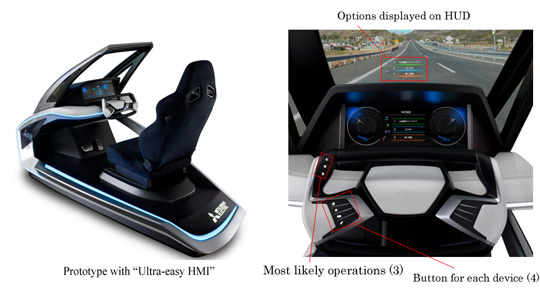
Mitsubishi Electric developed an in-car system that figures on driver’s operation. With the help of the history of driver’s operation, it guides him to the destination and to the nearest gas station when gas is going to run out. The system combines data of operation history, such as tuning the radio to the favorite station and talking with a specific person at specific time, with current traffic information and figures on the next operation of the driver. 


The driver can show the place he is going to visit and the person he is going to call on the display. He can show candidates on the display only by uttering the name of the place and the person he wants call. The company wishes to put the technology into practical use after 2018. For further details, please click here.

Wednesday, February 12, 2014

No. 833: Producing a plastics raw material from seawater and carbon dioxide (February 11, 2014)

Technology:
Yasuaki Einaga of Keio University and Kazuya Nakata of Tokyo University of Science jointly developed a technology to synthesize formaldehyde, a raw material of plastics and adhesive, from seawater and carbon dioxide. The technology generates gas by electrifying in seawater with the help of an electrode made of artificial diamond and collects generated gas to produce formaldehyde. Hydrogen ions contained in seawater react to carbon dioxide and generates formaldehyde. Theoretically, it is possible to produce formaldehyde inexhaustibly with seawater and carbon dioxide. In addition, the technology will be of great help for effective utilization of carbon dioxide recovered from manufacturing plants and thermal electric power plants. The research team will advance the technology for practical application in alliance with chemical companies.

It is possible to use a carbon electrode to synthesize formaldehyde, but the generation efficiency is 20% at most. However, the new technology successfully increased the generation efficiency to about 74%, and it does not need high temperature and high pressure. Besides, it needs only small amount of electricity for synthesis. Low electricity expense makes the new technology highly competitive in terms of production cost. However, it is a critical issue how to develop large diamonds at low cost for practical application because the new technology needs an electrode made of artificial diamond. Currently, formaldehyde is synthesized by adding high temperature and high pressure to methanol made of natural gas and coal. World production of formaldehyde is 8 million tons per year at present.   

Plastics made of rice
Efforts are being made to create plastics
without relying on oil

Tuesday, February 4, 2014

No. 832: Developing smart cars stimulates related industries (2/2) (February 3, 2014)

Business trend:
Japanese electronics manufacturers will commercialize the technology that assists safety driving one after another. Clarion developed a system for automatic garaging in alliance with Hitachi Automotive Systems. The system automatically detects space available for parking and operates the steering wheel automatically with the help of the in-car camera. The company has already started selling the system to automakers with a view to commercializing it in 2018.  

Pioneer will launch an information communication terminal that incorporates a liquid crystal touch screen in the rearview mirror. The terminal displays maps and road information via the Internet and allows the driver to see the information without moving his visual line greatly as compared with the standard car navigation system. It has the function to collect and transmit the traveling data. Pioneer plans to provide leading automakers with data necessary for the development of automated driving. 

 A liquid crystal display incorporated in the rear view mirror

Jcvkenwood developed a system that displays the situation of the rear on the liquid crystal screen in the driver’s seat. The side mirrors are replaced by small cameras that transmit images to the liquid crystal screen. The system can improve fuel efficiency besides helping the driver detect a pedestrian even at night. The smart-car related market will supposedly grow three times as big as today to 5 trillion yen in 2018.    

Please enjoy night driving on an express highway
through the screen of a Jcvkenwood navitation system

Monday, February 3, 2014

No. 831: Developing smart cars stimulates related industries (1/2) (February 2, 2014)

Business trend:
Today, about 1,000 million cars are running on the earth, and people trade information using 1,500 million PCs and 1,800 million smartphones. Automakers naturally ally with IT-related companies to develop smart cars as epitomized by the alliance between Google and leading automakers including GM and Honda. The development of smart cars is now crucial for every automaker in the world. Fujitsu collects and analyzes information, such as location and speed, from 4,000 taxies traveling inside Tokyo. It receives 23 million data every day and combines them with information on weather, traffic, and dangerous points besides information coming from social networking services. Fujitsu’s service allows taxi drivers to know the places from which smartphone users complain how hard it is to get a taxi.

The move to develop smart cars stimulates related industries. Demand for electronic parts vital to smart cars is growing fast. Toshiba plans to mass-produce sophisticated semiconductors for image processing starting last half of this year. Toshiba’s semiconductor can process images of four in-car cameras at the same time, and Toshiba plans to develop even more powerful and sophisticated semiconductors. Panasonic unveiled its information system that allows a car driver to check the instruments and display devices quickly and easily. It is developing a system that allows a car driver to operate such actions as closing the door, turning on and off the air-conditioner, and performing automatic parking using his smartphone. Nidec acquired Honda Elesys with a view to participating in the market by developing a technology for fuel efficiency and better maneuverability with the help of electronic control unit.

Makers of car navigation systems also plan to participate in the market because the spread of smartphone decreases sales of car navigation systems. Pioneer allied with NTT DoCoMo to provide car goods dealers and nonlife insurance companies with driving information based on big data. Clarion developed an automatic parking system in alliance with Hitachi. It will grow more important for every automaker to make their cars more appealing in alliance with IT companies instead of pursuing only such traditional yardsticks as speed and fuel efficiency. 

Fujitsu utilizes big data for safer and more 
convenient traffic systems 

Panasonic participates in the smart car
development competiton

Tuesday, January 28, 2014

No. 830: Japanese technology involved in the IC transit card increases the presence in Southeast Asia (January 28, 2014)

Technology:
The Japanese government will export the payment system that uses IC cards to Vietnam coming May as part of its official development assistance (ODA). A total of 200,000 IC cards complete with necessary equipment will be provided to Vietnam for users of route buses in Hanoi for free. The IC card to be exported is Sony’s contactless IC card Felica. Japan International Cooperation Agency collaborates with Sony, NTT Data, and Dai Nippon Printing. The total investment is expected to be 100 million yen all of which will be paid by ODA. In the initial stage, 26 buses travelling about 30 km from north to south inside Hanoi will accept the IC commuter ticket service in June. When the IC commuter ticket service spreads enough, the prepaid system will be introduced. Local production of IC cards will start in May, and the toll collection system and card readers will be installed at the same time.

The Japanese government plans to expand the market of Japanese IC transit cards to Thailand and India. Hong Kong, Bangladesh, and Singapore have already introduced the Japanese IC transit card system. There are several IC card specifications for public transit in the world. As compared with the Type A widespread in western countries, the Japanese IC card has a built-in chip higher in performance and needs less time for reading at the time of payment. In addition, it can store more information and easily support transfer. Once the Japanese system spreads in Asia, Japanese can move and shop easily during their stay in Asia and the market of IC-card supporting products including buses, rolling stocks, and vending machines will expand. The Japanese government plans to increase exports of infrastructure to 30 trillion yen by 2020.  

You can travel anywhere in Japan only with your IC transit card
No need to buy a ticket for each railway service

Automatic ticket gates of JR East
 

Monday, January 27, 2014

No. 829: IT helps increase the quality of green tea products (January 27, 2014)

Technology:
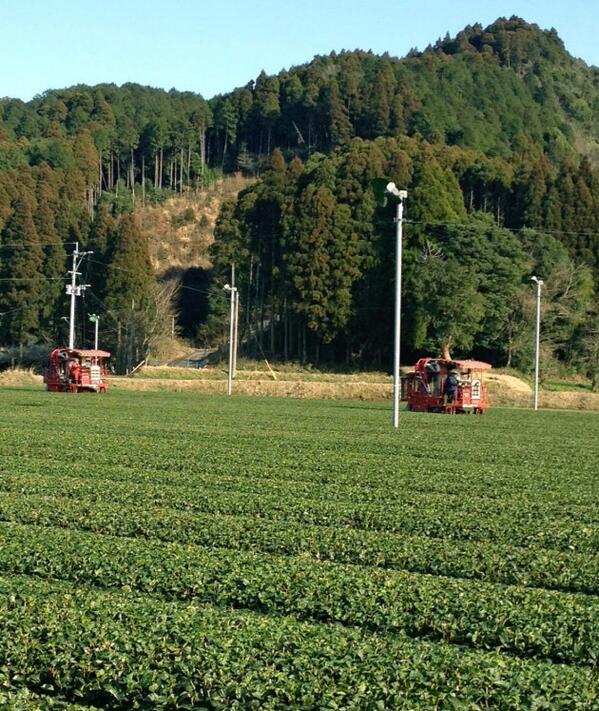
Itoen, unquestionably Japan’s leading maker of green tea products, will introduce an IT-based system to increase the quality of its products. The company will install special sensors in tea plantations and manage the growth of tea leaves by combining the data sent by the sensors with the images coming from an artificial satellite to know the most appropriate time to pick the tea leaves. Irradiating tea leaves around with light of a special wavelength, the sensors detect and digitalize their growing degree and tint. The images coming from the artificial satellite are used to manage the whole of a tea plantation. The special sensor is the same size as a security camera, and Itoen plans to install about 10 units in every 100 hectares. 

 Sensors installed in a tea plantation

Itoen has been developing this system in alliance with Nagasaki University, and the system will be put it into full scale operation in 2016. It will supposedly cost 10 million yen to install equipment of this system, but the investment can be recouped in a few years. Besides increasing the quality of tea leaves, utilizing IT will increase crop yields and eliminate the necessity of seeing around tea plantations. The personnel cost will be reduced to a quarter of the current level. Itoen currently procures nearly 90% of tea leaves it demand from the market and plans to decrease the share to 60% by increasing the contracted tea plantations that introduce the IT-based system. This approach will enable Itoen to stabilize the raw material cost, strengthen the traceability, and launch tea products that use only a specific tea plantation for consumers sensitive about taste and flavor.

The Japanese government has already announced the plan to integrate abandoned fields to increase the productivity of Japan’s farm products. This government drive is expected to facilitate the spread of an IT-based system in the agricultural industry. 

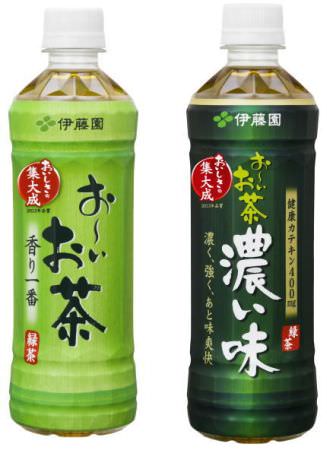
 “Ohi Ocha (Hallo green tea)” dominant in 
the Japanese green tea market

The happiest moment given by a cup of green tea