Thursday, April 24, 2014

No. 840: Developing resin with the help of wood is accelerating (April 23, 2014)

Technology:
Chemical companies are accelerating the development of resin for auto parts and artificial leather with the help of wood from the viewpoint of preventing global warming. Sumitomo Bakelite successfully changed lignin, which is currently used mainly for the fuel of boilers in paper mills, into thermosetting resin. The company reveled out wood and powder of tree bark and improved part of the molecule structure. The resin made of this material has the same performance as the conventional phenol resin. The auto parts made of this resin are being evaluated by auto parts makers. The company plans to commercialize the resin in 2018. Mitsubishi Chemical discovered a manufacturing process of increasing the efficiency of converting hemicellulose, which is one of the wood components, to a raw material of resin. At the present stage, the new material can be made for only several hundred grams in a laboratory per day, but the company plans to build large-scale equipment within the year to study the feasibility.

While shale gas production is expected to grow rapidly in the future, naphtha that is the raw material of synthetic fiber will supposedly be in short supply because oil production will dwindle. Consequently, the technology to replace oil with wood invites attention. Currently hemicellulose of wood replaces butadiene and lignin of wood replaces benzene. Each of hemicellulose and lignin accounts for 15-35% of wood components. New Energy and Industrial Development Organization (NEDO) launched a project to develop technologies to utilize every component of wood. 

 Company profile of Sumitomo Bakelite

Tuesday, April 22, 2014

No. 839: Improving containers to extend the use-by date of foods (April 22, 2014)

Technology:
Materials makers are introducing new containers that extend the use-by date of foods. Toyo Seikan Group, Japan’s largest container maker, developed a plastic container that allows long-term preservation. Adopting multilayer coating of aluminum foil and special film, the company successfully extended the use-day of content from several months to three years, which is the used-by date realized by a metal can. A leading supermarket chain adopted this container for its private brand corned beef. Its corned beef contained in this plastic is 60% lighter than the conventional canned corned beef, and it can be opened easily even by the elderly.

Nippon Paper developed a recyclable drink box that allows preservation for several months at normal temperature. Using film that prevents quality deterioration, the company eliminated the necessity of aluminum foil required to prevent light from penetrating. The new drink box has been adopted by a new vegetable drink of Itoen, and it receives an inquiry from more than 10 drink vendors. Kuraray will apply its EVOH resin excellent in interrupting oxygen to containers for prepared foods. EVOH has about 7,000 times higher performance to interrupt oxygen. The considerably higher interruption performance expands the use-by date of food. An experiment verified that EVOH successfully expanded the use-by date by more than three times.

Retailers, wholesalers, and food makers are jointly working on the reduction of food waste. A total of 35 companies involved in the food business introduced a new rule to reduce returned foods last August. The government also backs up the efforts to reduce food waste.

Prepared foods in the container made of Kuraray’s EVOH    
 

Thursday, April 10, 2014

No. 838: Reducing nitrogen oxide in the exhaust fume of ships by 76% toward 2016 (April 10, 2014)

Technology:
Mitsui Engineering and Shipbuilding is scheduled to make equipment that reduces nitrogen oxide in the exhaust fume of ships by 76% practicable in 2016. The equipment is combined with the engine and installable inside the machine room. It will be installed in the bulk freighter introduced by NYK Line in 2015 and undergo demonstration experiment for several thousand hours to examine durability. It successfully reduced nitrogen oxide about 25% in the experiment conducted on land. NGK Insulators developed a technology to eliminate soot completely by applying the technology it developed for vehicles. The purification equipment developed by the company is based on the ceramic technology it has accumulated. All soot in the exhaust fume of a marine diesel engine is completely eliminated by the ceramic filter when it goes through the equipment. 

Regulation on exhaust fume of ships is behind that of vehicles, but it will grow stringent worldwide beginning in 2016 because International Maritime Organization asked ships to be built after 2016 to reduce nitrogen oxide emissions by 80% from the level of 2010. In the future, regulation on soot is expected to be introduced.     

Mitsui Engineeering and Shipbuilding is 
very active in robotics, too

NGK Insulators means ceramics

Monday, April 7, 2014

No. 837: Increasing the distance per charge of an electric vehicle by 30% (April 7, 2014)

Technology:
Daikin Industries and Nippon Kodoshi Corp. developed a technology to increase the heat resistance of lithium-ion battery used for electric vehicles. The new technology not only eliminates the necessity of a device to cool the lithium-ion battery for lower power consumption but also makes the auto body lighter. Accordingly, the distance per charge can be increased by 30-40%. At the same time, it can prevent an accident due to ignition and increase the safety of lithium-ion battery. A lithium-ion battery deteriorates the performance should temperature rise above 45 degrees centigrade. To avoid the deterioration, an electric vehicle carries a cooling device. Because the cooling device runs at its full capacity in summer, the distance per charge decreases by 30%. Without a cooling device, the temperature of a lithium-ion battery rises close to 60 degrees centigrade.

Daikin developed highly heat resistant electrolyte and electrode in alliance with Kansai University. They used fluorine for the substance of electrolyte and confirmed that it worked without any problem at 60 degrees centigrade. They adopted a highly heat resistant adhesive for the electrode to prevent the adhesive from eluting off. They have already shipped trail electrolyte to auto maker and battery makers. The technology is scheduled to be put into practical use in 2020.

Nippon Kodoshi developed increase the heat resistance of electrode and separate in alliance with Advance Industrial Science and Technology. They processed plant fibers elaborately and developed a separator that neither shrinks nor decreases the performance at a high temperature as the existing resin film. At the same time, they adopted a highly heat resistant adhesive. The company has already started to ship samples with a view to putting the technology into practical use in five years.

An electric vehicle jointly developed by 
Daikin and Mercedes-Benz Japan

Wednesday, February 19, 2014

No. 836: Supersensitive thin-film transistor that detects the change of faint electric signals (February 20, 2014)

Technology:
Toray built a supersensitive thin-film transistor (TFT) that detects the change of faint electric signals. Using a composite material of carbon nanotube, the company realized the sensitivity that is more than 10 times higher than that of the existing thin-film transistor made of silicone. It can allow a flat screen TV to display the video much faster, and can be applied to a biosensor to detect a tiny amount of protein in the blood. The company plans to put the new TFT into practical use in 

The new TFT adopted a composite material made of carbon nanotube of 95% purity and a polymer molecule. Because the purity is rather high, the composite material can be a thin film uniformly for higher sensitivity. In addition, it can be built by an ink-jet printer, and the production cost is one fifth of that of the existing amorphous silicon transistor. If the change of faint electric signals created when blood is dropped on the TFT can be detected, the new product can be used to examine blood component. And it can be a high sensitive biochip to tell whether a small amount of protein is contained. Toray wishes to practicalize the new TFT as a blood sugar level sensor for diabetic patients.

 Toray's technology on organic TFT liquid crystal display
 

No. 835: Preventing a driver from falling into a doze using a smartphone (February 19, 2014)

Technology:
Toshiba and a car goods maker Carmate will jointly put a system to prevent a driver from falling into a doze on the market. The system is made up of a smartphone and a biosensor to measure heart rate. The driver of a vehicle puts a smartphone that incorporates the special application software inside the vehicle and wear a biosensor. The image recognition sensor and acceleration sensor built in the smartphone collect the running date of the vehicle in real time and estimate the distance to the preceding vehicle and usage of the brake. 

The image of the system to prevent snooze

Data will be transmitted together with heart rate obtained from the biosensor to the server managed by the Toshiba group. By analyzing the incoming data, the system will give the driver an audio warning not to fall into a doze. Toshiba Information System and Carmate are scheduled to start to offer this service for a monthly fee of several hundred yen in January 2015. The two companies plan to sell operators of long-distance buses and taxi companies for the health management of their drivers. 

 A revolutionary device to prevent a driver
from falling into a doze?

Thursday, February 13, 2014

No. 834: An in-car system that figures on driver’s operation (February 12, 2014)

Technology:
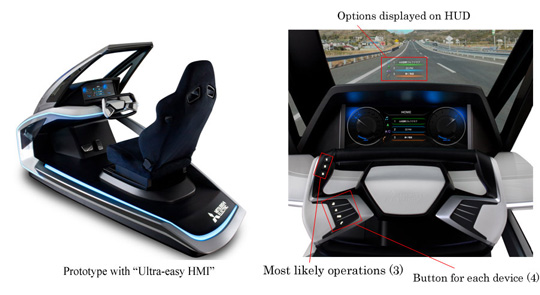
Mitsubishi Electric developed an in-car system that figures on driver’s operation. With the help of the history of driver’s operation, it guides him to the destination and to the nearest gas station when gas is going to run out. The system combines data of operation history, such as tuning the radio to the favorite station and talking with a specific person at specific time, with current traffic information and figures on the next operation of the driver. 


The driver can show the place he is going to visit and the person he is going to call on the display. He can show candidates on the display only by uttering the name of the place and the person he wants call. The company wishes to put the technology into practical use after 2018. For further details, please click here.